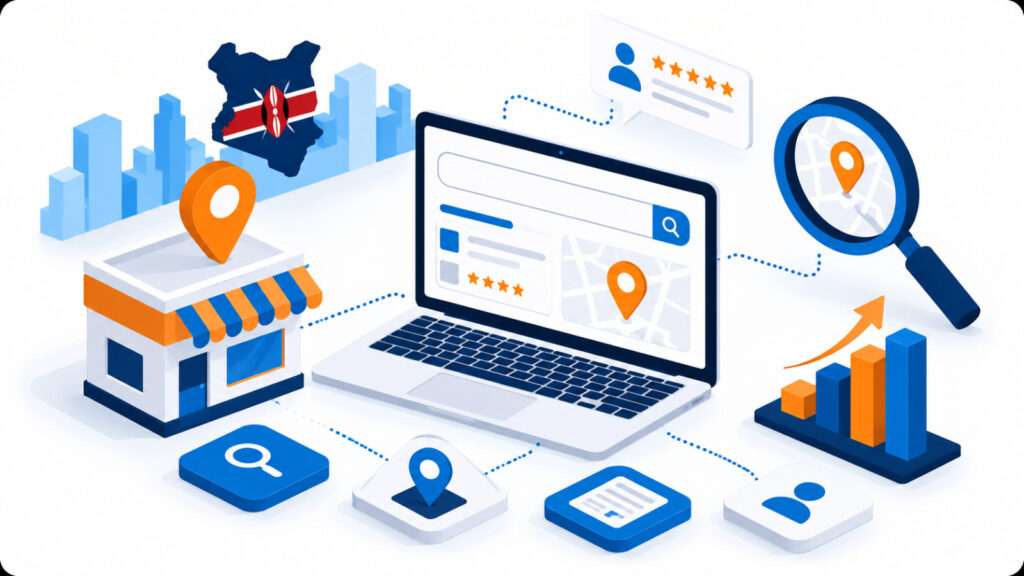
Type “web design company near me” or “best hardware shop in Nairobi” into Google. The results you see are not random. They are shaped by local SEO: ranking signals that tell search engines which businesses actually serve an area. If your business has a physical location, or serves specific towns in Kenya, local SEO matters directly. Skip it, and you lose customers to competitors, even when your product is better.
What Local SEO Actually Means for a Kenyan Business
General SEO tries to rank a website for any searcher, anywhere. Local SEO narrows that goal. It focuses on searchers who are nearby, or who add a place name to their query, such as “plumber Kisumu” or “boutique hotel Diani”. As a result, local SEO leans on a different mix of signals. These include your Google Business Profile, customer reviews, and how consistent your business details are across the web.
In practice, this distinction matters more to most Kenyan SMEs than national rankings ever will. A salon in Nakuru does not need to outrank one in Mombasa. It needs to be the first result a Nakuru resident sees. That is what local SEO is built to deliver.
Start With Your Google Business Profile
Before touching anything else, claim and verify your Google Business Profile, formerly Google My Business. In fact, for most small businesses, it is the single biggest driver of local search visibility, and it costs nothing to set up. Once verified, take the time to:
- Choose the most accurate primary category for your business, not just the closest match.
- Add complete, correct opening hours, including holiday exceptions.
- Upload real photos of your premises, products, and team.
- Reply to every review, positive or negative, in a professional tone.
Still, a profile that is filled in properly, and kept current, consistently beats one that was set up once and then forgotten.
Get Your Website Fundamentals Right
Local SEO does not stop at your Google profile. Your site still needs to load quickly and work well on a phone. It also needs to list your business name, address, and phone number the same way everywhere online. Search engines read inconsistent details, such as one listing showing “Rd” and another showing “Road”, as a small trust problem. Over time, small trust problems add up, and they quietly hold a listing back.
Site speed deserves particular attention. A slow-loading page pushes visitors back to the results before they see your offer. Because hosting performance directly affects load times, it is worth checking whether your current web hosting plan can handle your traffic. This matters most if you are still on an entry-level shared package after your business has grown.
A business that ranks first but loads slowly still loses the customer. Local SEO and site performance are two sides of the same problem.
Earn Local Trust Signals
Search engines lean heavily on signals they cannot fake themselves. That is why reviews, citations, and local backlinks carry so much weight. A citation is simply a mention of your business name, address, and phone number on another website, such as a directory. Because of this, an accurate listing on a handful of reputable Kenyan directories beats appearing on dozens of low-quality ones.
In much the same way, reviews build trust over time. A steady trickle of new, genuine reviews signals an active, trusted business. Old reviews with nothing since suggest the opposite. Consequently, it helps to build a simple habit: ask satisfied customers for a review right after a purchase, rather than requesting a batch of them once a year.
Measure What Is Actually Working
In short, local SEO is not a one-time project. It is an ongoing habit. Your Google Business Profile dashboard shows how customers found you, what they clicked, and whether they called or asked for directions. Meanwhile, Google Search Console shows the exact terms bringing traffic to your site. Together, these two free tools show what is working and what needs adjusting.
According to Google’s own documentation on local search, profile completeness and recent activity are consistently tied to local visibility. Therefore, revisiting your listings every few months is not wasted effort. In fact, it is one of the highest-return tasks a small business owner can do, since it costs only time.
Building Local SEO Into How You Operate
None of this needs a large marketing budget or a dedicated specialist. Rather, it needs consistency: a complete profile, a fast and mobile-friendly website, matching details everywhere, and a habit of collecting reviews. Put those pieces in place, and local SEO stops being abstract. Instead, it starts sending real customers through your door, month after month.
Would you like a second opinion on whether your website is holding your rankings back? Feel free to get in touch and we will take a look.