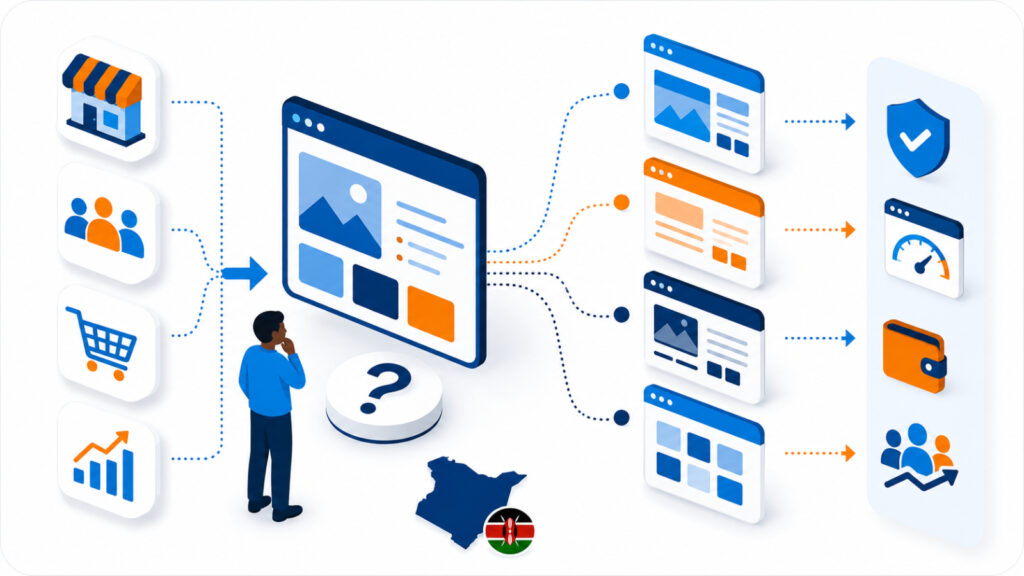
Choosing a website platform is one of the first big decisions a growing Kenyan business makes online. It rarely gets the attention it deserves. Many owners simply pick whatever a friend used last, or whatever a developer suggests. Then they move on. That approach works fine for a year or two. However, it tends to fall apart exactly when the business starts growing and the website needs to keep up.
A website platform is not just a technical detail hidden behind the scenes. It shapes how fast your pages load. It also affects how easily your team can add new content. In addition, it determines how much a future redesign will cost, and how exposed you are to security problems. Choose well, and your website becomes an asset that grows alongside your business. Choose poorly, and you may end up rebuilding from scratch within two or three years, often at the worst possible time.
Why Choosing a Website Platform Matters More Than It Looks
Most small business owners in Kenya do not think about their website platform until something breaks. A page loads slowly. An update needs a developer you can no longer reach. Or a competitor’s site suddenly looks far more modern than yours. At that point, the choice made years earlier starts to feel like a limitation rather than a foundation.
Every platform makes a tradeoff between flexibility, cost, and the technical skill you need on hand. Those tradeoffs are rarely obvious at the start. As a result, many businesses end up with a platform that fit their needs on day one but no longer fits three years later. Understanding the main options before you build, rather than after, saves both money and frustration.
The Three Main Options for a Kenyan SME
When choosing a website platform, most Kenyan businesses are really deciding between three broad categories. Each one suits a different stage of growth. Each also demands a different level of hands-on management.
WordPress and Similar Content Management Systems
WordPress powers a large share of the websites online today. It balances flexibility with ease of use better than most alternatives. You can manage content yourself once it is set up. You can also extend it with plugins for almost any feature. Later, you can hand it off to a new developer without starting over. For most SMEs that need a professional site without an in-house tech team, a well-built WordPress website is often the most practical starting point.
The tradeoff is ongoing maintenance. Plugins need updates. Security needs attention. A poorly configured install can run slowly. None of this is difficult, but it is not something you can ignore indefinitely.
Website Builders
Drag-and-drop builders appeal to businesses that want something online quickly. They suit owners who do not expect to need much customization. That simplicity comes at a cost, though: limited flexibility, awkward migration later, and templates that start to look generic once competitors use the same ones.
For a very small business testing an idea, this can be a reasonable first step. For anyone planning to grow, it is usually a short-term fix rather than a lasting platform.
Custom-Built Systems
A custom-built website makes sense once your business has workflows no off-the-shelf platform handles well. A booking system, a customer portal, or a link to an internal database are common examples. Custom builds cost more upfront. They also require a capable developer to maintain. In exchange, they remove the ceiling that pre-built platforms eventually hit.
As a rough rule, if your website’s needs sound like “catalogue,” “contact form,” and “blog,” a content management system will likely serve you well. If instead you keep describing a workflow unique to your business, custom development is worth exploring.
Questions to Ask Before Choosing a Website Platform
Rather than starting with a platform name, start with your own requirements. A short list of honest questions points you toward the right answer far more reliably than following whatever is currently popular.
- Who will update the website day to day, and how comfortable are they with technology?
- Do you expect to add online payments, bookings, or a customer login area within two years?
- How much are you willing to spend on ongoing maintenance, not just the initial build?
- Do you want a developer for every small change, or do you want to manage content yourself?
- Does the platform have healthy support and documentation, in case you switch developers later?
Answering these honestly before a single line of code is written makes the difference. It separates a website that serves your business for years from one that needs replacing within twelve months.
The best website platform is not the most powerful one available. It is the one that matches your team’s ability to manage it and your business’s actual growth plans.
What Getting This Right Means for Growth
A well-chosen platform does more than keep your site online. It affects how quickly you can respond to opportunities, for example launching a seasonal promotion or adding a new product line. Businesses that outgrow their platform usually notice it first as a delay. A change that should take an afternoon instead takes weeks, because the underlying system cannot easily support it.
According to usage statistics tracked by W3Techs, content management systems now power the majority of websites worldwide. That is a strong signal. Flexible, well-supported platforms have become the practical default for most businesses, not the exception. The same trend holds in Kenya, particularly for SMEs that cannot justify a large in-house development team.
None of this means every business needs the most sophisticated setup available. It simply means the decision deserves a few hours of genuine thought, not a default choice made in a hurry.
The Real Cost of Getting It Wrong
Switching platforms later is rarely as simple as moving files from one folder to another. A migration usually means rebuilding pages, testing every form and integration again, and watching search rankings dip while search engines re-index the new site. None of that is disastrous on its own. Together, however, it adds up to real cost and real risk, often at a time when the business can least afford the distraction.
This is especially true for Kenyan businesses that depend heavily on mobile traffic. Many customers browse on modest data plans, so a platform that loads slowly or breaks on older devices quietly costs sales every day, even when nobody complains directly. A platform chosen with growth in mind avoids most of this pain later, because it was built from the start to handle more traffic and more features.
Choosing a Website Platform With Confidence
If you are weighing your options, separate the decision from any single vendor’s pitch. Focus on your own workflow first. Then weigh your budget for ongoing maintenance. Finally, consider how much you expect your website to do in two years, not just today. A platform that looks impressive in a demo is not necessarily the one that serves your business well once real customers and real growth start testing it.
Choosing a website platform carefully at the outset is one of the cheapest forms of insurance a growing business can buy. It costs far less than discovering the wrong choice after your site is already central to how customers find and trust you. If you would rather talk through your options than guess, our team is happy to help. Get in touch through our contact page whenever you are ready.