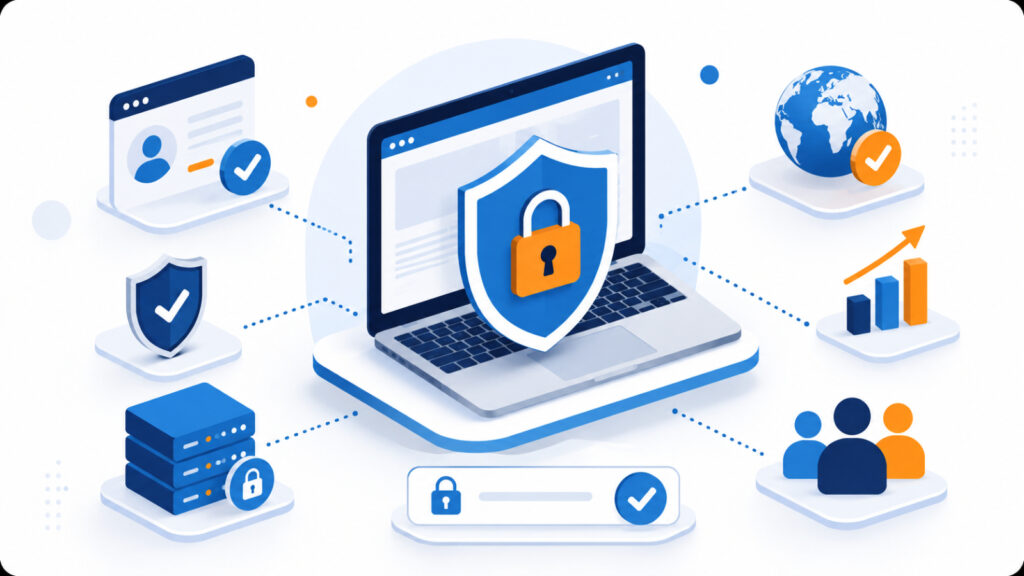
Open any website without an SSL certificate today and Chrome greets you with a blunt warning: “Not Secure.” That single label, sitting right in the address bar, is often the first thing a potential customer sees before they read a word of your homepage. For a Kenyan SME trying to build trust online, that is a rough way to start a relationship.
An SSL certificate is the small file that encrypts the connection between a visitor’s browser and your web server. It is also, increasingly, a baseline expectation rather than a nice-to-have. If your business still runs a site without one in 2026, you are quietly losing customers who never tell you why they left.
What an SSL Certificate Actually Does
An SSL certificate scrambles data as it travels between your visitor and your server, so anyone intercepting the connection sees gibberish instead of passwords, card numbers, or contact details. You can spot it instantly: the address bar shows a padlock and the URL starts with “https” instead of “http.”
This matters most obviously on pages that collect information, such as checkout forms or contact pages. However, it matters just as much on a simple brochure site, because browsers now treat the absence of encryption as a red flag regardless of what the page actually does.
Why Customers Notice, Even Without Knowing the Term
Most visitors cannot explain what an SSL certificate is, but they recognize the padlock icon and, more importantly, they recognize its absence. A “Not Secure” warning next to your business name does real damage, even if nothing on the page is actually risky.
A missing padlock does not just look technical. To an ordinary visitor, it reads as “this business did not bother,” and that impression forms in under a second.
As a result, bounce rates tend to climb on unsecured sites, particularly among visitors arriving from search or social media who have no existing relationship with the brand. Trust, once lost at the browser bar, is hard to win back on the same visit.
SSL and Your Search Rankings
Google has treated HTTPS as a ranking signal for years, and the gap has only widened since. A site with a valid SSL certificate has a small but real edge over an otherwise identical competitor without one, and Google’s own documentation confirms this is deliberate policy rather than an accident of crawling behaviour, as detailed in Google’s official guidance on HTTPS and search.
For an SME competing for local search visibility, that edge is not something to give away for free. Every other page in the results is likely already secured, so an unsecured site does not just miss a bonus, it starts the race a step behind.
The Real Cost of Skipping One
Skipping SSL rarely shows up as a single dramatic incident. Instead, it shows up as a slow leak: a slightly higher bounce rate here, a customer who quietly closes the checkout tab there, a search ranking that never quite climbs as high as it should. None of these get logged as “lost because of missing SSL,” yet together they add up to real revenue.
There is also a compliance angle. Any business collecting customer data, even something as simple as a contact form or newsletter signup, is expected to protect that data in transit. An unsecured site puts both the business and its customers at unnecessary risk.
Free vs Paid SSL Certificates
Not every SSL certificate costs money, and for most SMEs that is good news. Free certificates, issued through automated authorities, encrypt a connection exactly as well as a paid one for standard business and ecommerce sites. Paid certificates mostly add extended validation branding or higher liability coverage, features that matter more for large financial institutions than a local retailer or service business.
- Domain Validated (DV): confirms you control the domain; free and automated; suitable for most SME websites.
- Organization Validated (OV): confirms basic business details; usually paid; a step up for businesses that want extra credibility signals.
- Extended Validation (EV): the most thorough vetting; typically reserved for banks and large ecommerce platforms.
For the vast majority of Kenyan SMEs, a free, automatically renewing DV certificate covers every practical need without adding an ongoing line item to the budget.
Getting SSL Right for Your Business
The good news is that installing an SSL certificate is no longer the manual, technical chore it once was. Most modern web hosting plans include free SSL certificates that install and renew automatically, so there is rarely a reason for a live business site to run without one today.
If you are unsure whether your current site is secured, check the address bar right now. No padlock means it is worth a conversation with whoever manages your hosting, before a customer notices before you do.
An SSL certificate will not fix a slow site or a confusing layout on its own, but it removes one of the easiest reasons for a first-time visitor to leave without trusting you. In a market where customers judge a business by its website within seconds, that is not a detail worth skipping.