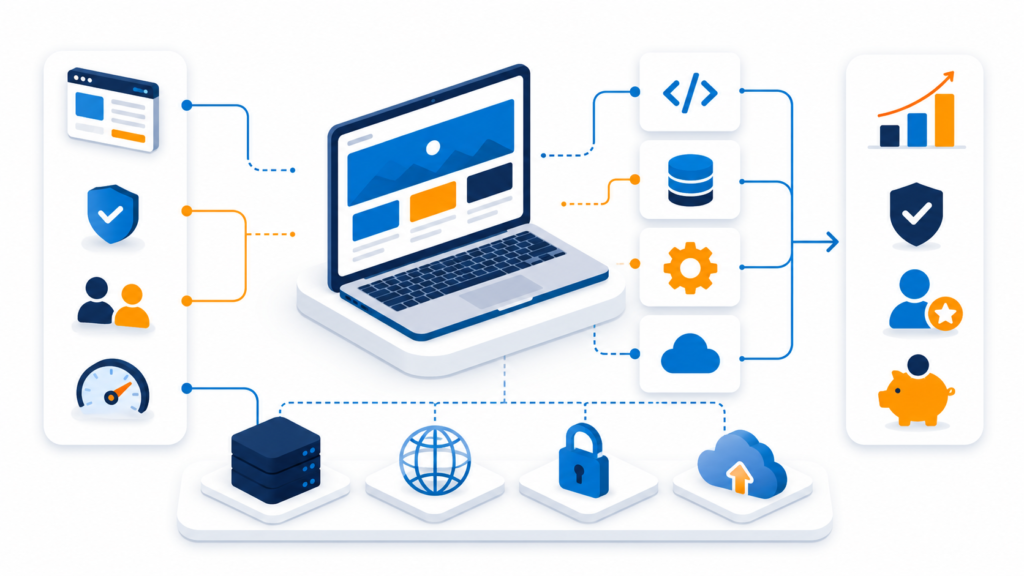
Ask five web developers what your business should build on, and you will likely get five different answers. That is the trouble with finding the right tech stack for a small business website. Everyone has a favorite tool, but few people start with your actual goals. The right tech stack is not the one your cousin’s developer prefers. It is the one that matches your budget, your growth plans, and how much control you need over the finished site.
For Kenyan SMEs building or rebuilding a website this year, this decision carries real weight. For example, traffic increasingly arrives on mobile, and a site that ignores this fact loses visitors before it ever gets a chance to convert them. Budgets are tight, and a wrong turn early on can mean rebuilding from scratch eighteen months later. Instead of chasing whatever tool is trending, this piece walks through how to actually think about the choice.
What a Tech Stack Actually Means for Your Business
A tech stack is the combination of technologies used to build and run your website. It includes the platform or framework, the database, and the hosting environment. In addition, it covers any tools layered on top for payments, email, or analytics. A large enterprise might run custom infrastructure with a full engineering team behind it. For most SMEs, however, the real decision is much narrower.
It usually comes down to three broad paths. The first is a website builder or content management system such as WordPress. A custom-built web application makes up the second option. Third, there are platforms designed specifically for online selling. None of these options is universally better than the others. A restaurant needs a menu, a location, and a booking form. A logistics company wants clients to track shipments online. Those are very different jobs. As a result, the first mistake to avoid is choosing a stack because it is popular, rather than because it fits the job at hand.
How to Find the Right Tech Stack for Your Needs
Before comparing platforms, answer a few blunt questions. What does the site actually need to do? Who will update it after launch, and how technical are they? How much can you realistically spend, both now and on ongoing maintenance? How fast do you expect the business to grow over the next two or three years? Therefore, these answers matter more than any feature list a vendor hands you.
A brochure-style website for a school or a healthcare clinic rarely needs custom software. A well-built WordPress or CMS-based site can look professional and stay easy to update, often for a fraction of the cost of a custom build. On the other hand, a SACCO managing member contributions faces different demands. So does a company running its own booking and inventory system. Both usually outgrow off-the-shelf tools within a year or two. In that case, a purpose-built web application is worth the extra investment, because it removes the workarounds a generic platform would otherwise force on you.
Comparing the Common Options in Kenya
Three patterns show up again and again among small and medium businesses in Kenya. Also, each one tends to suit a different stage of growth.
- Content management systems (WordPress and similar): Fast to launch and relatively affordable. Flexible enough for most informational sites or small online stores. Best suited to businesses that need a professional presence without heavy custom logic.
- Custom web applications: Built specifically around a business process, such as client portals, booking systems, or internal dashboards. This route costs more upfront, but it avoids the compromises of squeezing a unique process into a generic tool.
- Dedicated e-commerce platforms: Purpose-built for product catalogs, checkout flows, and inventory tracking. A better starting point than a general CMS once online selling becomes the core of the business.
Because of this, the right answer often changes as a business matures. A shop that starts on a simple CMS may later need a dedicated e-commerce build once order volumes grow. That is a normal progression, not a sign that the first choice was wrong. In fact, most growing businesses in Kenya move through more than one stack over the years, and that is perfectly fine.
Signs You Have Chosen the Right Tech Stack
A good fit usually feels quiet. For example, pages load quickly, and staff can make small edits without calling a developer every time. In addition, the site handles a busy month without breaking. If any of those things feel hard today, treat it as a signal worth paying attention to, not something to just push through.
The cheapest option today is not always the cheapest option over three years. Maintenance, scalability, and flexibility usually cost more than the sticker price suggests.
Mobile performance deserves specific attention here. In Kenya, mobile devices account for the large majority of internet traffic, according to the Communications Authority of Kenya. Therefore, a stack that renders beautifully on a laptop but loads slowly on a mid-range phone will quietly cost you customers. This holds true no matter how modern the underlying framework is.
Questions to Ask Before You Commit
A short checklist can save months of frustration later. First, ask whether the platform can grow with you, or whether you are likely to hit a ceiling within a year. Second, ask who owns the code and content once the project is done. This matters because some agencies build on proprietary systems that make it difficult to move your site elsewhere later.
Third, ask about ongoing costs. Licensing, hosting, security updates, and support are all part of the real price, not just the initial build fee. Finally, ask for examples of similar projects the team has delivered. A developer who has built for a school is not automatically the right fit for a SACCO or an e-commerce brand, because the underlying requirements differ too much.
Getting the Right Tech Stack Decision Right From the Start
A mismatched tech stack rarely fails loudly. Instead, it shows up as slow page loads, or a website that is hard to update. In addition, it often looks like a business paying a developer every month just to make small text changes. Over time, these small frictions add up to real cost, in both wasted budget and lost customer trust.
Choosing well from the start does not mean choosing the most expensive or most advanced option available. It means being honest about what the business needs today, and what it will likely need soon. It also means being clear about who will be responsible for keeping the site running. A clear answer to those questions usually points to the right tech stack faster than any trend list can.
If you are still weighing your options, it often helps to talk the requirements through with a team that builds across CMS platforms, custom applications, and e-commerce systems. That is a better path than working with one that only offers a single approach, since a single-tool agency will naturally push you toward whatever it already knows best. Our digital transformation consultancy works through exactly this kind of decision with SMEs before a single line of code gets written. As a result, the stack you choose actually fits where the business is headed, rather than where a particular vendor happens to be strongest.