Walk into almost any shop in Nairobi, Kisumu, or Eldoret. You will see the same green till number taped to the counter. Mobile money is not a payment option in Kenya anymore. It is the default. So why do so many business websites still push customers toward a bank transfer, or a phone call to “arrange payment”? M-Pesa integration closes that gap. For a growing number of Kenyan businesses, it has quietly become the feature that decides whether an online sale happens at all.
If your website still treats payment as an afterthought, this is worth fixing soon. Here is what M-Pesa integration actually involves. It also covers why it matters more than most owners assume, and how to approach it without over-complicating your site.
Why Manual Payments Are Costing You Sales
Think about the last time a website asked you to “pay via M-Pesa and send a screenshot.” Most shoppers hesitate at that step, because it feels informal. It is slow, and it leaves room for mistakes on both sides. As a result, a customer who is ready to buy right now often just leaves instead.
This friction adds up over time. Businesses that rely on manual payment confirmation tend to see lower conversion rates than those with instant, on-site payment. Kenyan shoppers already trust M-Pesa for everyday spending. Because of that trust, removing the manual step is one of the fastest ways to make a website feel credible.
What M-Pesa Integration Actually Means
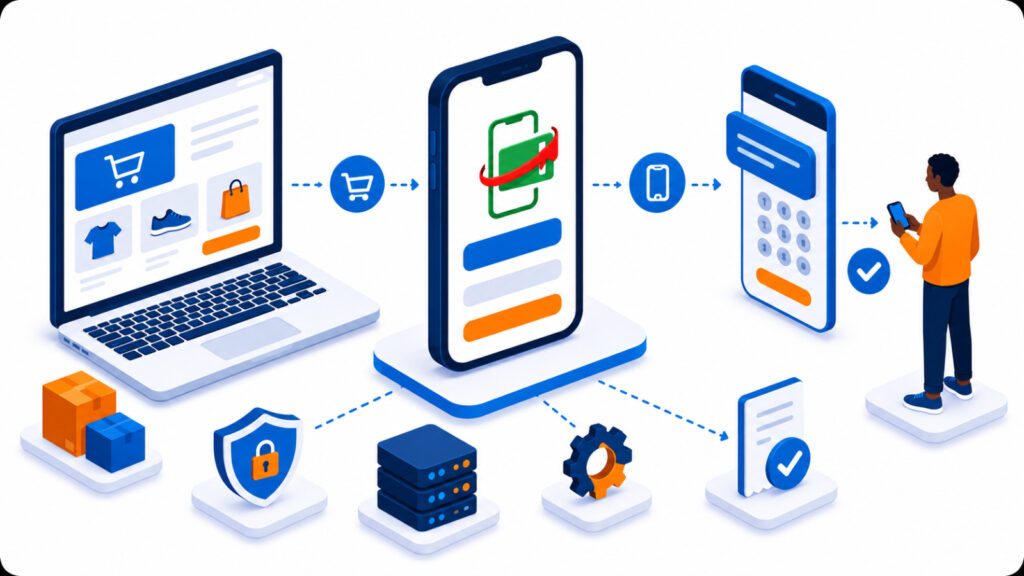
At a technical level, M-Pesa integration connects your website directly to Safaricom’s payment system, through an API known as Daraja. Instead of a customer sending money separately, the payment happens inside your checkout flow. A customer enters their phone number and receives an STK push prompt. They enter their PIN, and the transaction confirms automatically on your end.
You do not need to be a developer to understand why this matters. Payments that used to take minutes of back-and-forth messaging now settle in seconds. Every order also gets a clear digital record.
The Business Case for M-Pesa Integration
Beyond convenience, there are three practical reasons this matters for a growing business.
- Fewer abandoned carts. Every extra step between “I want this” and “I paid for this” loses customers. Automated M-Pesa integration removes several of those steps at once.
- Cleaner bookkeeping. Manual confirmation invites errors, disputes, and the occasional “I already paid” conversation that eats ten minutes. A direct integration logs every transaction on its own.
- A more credible image. An instant checkout signals a business that is established and organized. This matters more than most owners expect when a first-time customer decides whether to trust a new website.
A customer who has to text a screenshot to prove they paid is a customer being asked to do your bookkeeping for you.
Common Ways Kenyan Businesses Use M-Pesa Integration
There is no single correct setup. The right approach depends on how your business actually operates.
E-commerce Checkout
For online stores, M-Pesa usually sits inside the checkout page alongside other payment options. The customer never leaves your site. As a result, the order status updates the moment payment clears.
Invoicing and Service Payments
Service businesses, from consultants to logistics companies, often use it differently. They send a payment link, or trigger an STK push tied to a specific invoice. This approach keeps records tidy without needing a full online store.
Recurring or Subscription Billing
Businesses with memberships or repeat billing can automate the reminder and collection cycle too. Instead of chasing customers every month, the system does it for them.
Is M-Pesa Integration Only for Online Stores?
Not at all. This is a common assumption, and it holds a lot of businesses back from adopting it. A driving school, a clinic, or a small logistics firm has no shopping cart to speak of. However, each of these still collects payment from customers regularly, often over the phone or in person.
In each case, M-Pesa integration can sit behind a simple invoice, a booking form, or a service request instead of a product page. For instance, a clinic could trigger an automatic STK push once a patient confirms an appointment. A logistics firm could collect payment the moment a delivery is marked complete. In other words, the technology fits the workflow, not the other way around.
Because of this flexibility, almost any business that collects money from customers has a reasonable case for it, whether or not it sells physical products online.
What to Consider Before You Integrate
Before adding this to your website, work through a few practical questions first, rather than jumping straight into development.
First, decide whether you need a full custom build or a simpler plugin-based option. This choice depends heavily on the platform your website already runs on. Second, remember that Safaricom’s transaction charges apply on top of any development cost, so check the fee structure before you commit. Finally, treat security seriously. API credentials, callback URLs, and transaction logs all need proper handling, because a poorly configured integration can expose sensitive data or fail quietly during a sale.
This question connects to a wider one many business owners face: how to sell online in Kenya in the first place. That decision covers the platform and logistics side of the same problem.
It also helps to plan for scale early. A till number that works fine for ten orders a day can become a bottleneck at a hundred. Manual reconciliation, after all, does not grow at the same pace as your sales. Building the integration properly the first time tends to save far more effort than patching a workaround later.
Where Mobile Payments in Kenya Are Heading
Mobile money in Kenya keeps evolving past simple person-to-person transfers. Features such as Pochi La Biashara and QR-code payments show that Safaricom is pushing businesses toward faster, more automated collection. For a business owner, this trend matters because customer expectations move with it. A generation raised on tapping a phone to pay for matatu fare will not tolerate a clunky checkout for long.
As a result, businesses that invest in solid M-Pesa integration now are not just solving today’s friction. They are also positioning themselves for where payments are clearly headed. Waiting until competitors normalize instant checkout usually means playing catch-up later, often at a higher cost.
Getting Started the Right Way
You do not need to build this yourself, and for most businesses, it is not worth trying to. A properly configured M-Pesa integration touches your website’s backend, your Safaricom developer account, and your order or billing system, all at once. Because of that, getting it wrong tends to be expensive to fix later.
If your website already runs on solid hosting and a stable platform, adding payment automation is usually straightforward. It becomes a matter of connecting the right tools, rather than rebuilding anything from scratch. For a deeper technical look at how this works, Safaricom’s own Daraja API documentation is the authoritative reference.
Mobile money is not going anywhere in Kenya, and customer expectations around it keep rising. A business that makes payment effortless today is simply easier to buy from than one that does not. That difference shows up in the numbers by the end of the month.
If you would like help planning or building this into your website, our M-Pesa integration service covers exactly this, from checkout automation to recurring billing setups.